
The tactile rebellion of Poland's modern folk revival
A new generation is trading screens for looms and carving knives, pulling regional embroidery and traditional instruments out of the archives and into the underground.
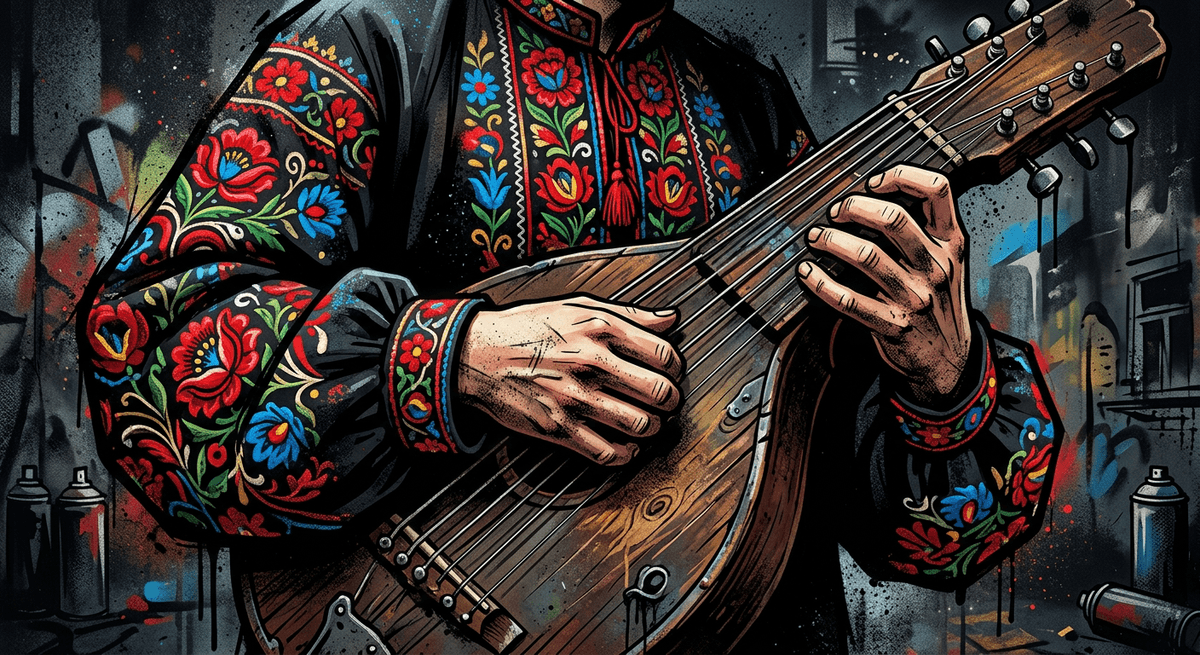
What is happening. The needle punctures the heavy linen with a sharp, satisfying snap. Across Poland, a sudden, vivid counter-movement is taking root—not in the slick corridors of modern design, but at the loom and the workbench. A new generation is reaching back into the archives of Polish folk art and dragging it, thread by brilliant thread, into the present. Regional embroidery, once relegated to the static displays of ethnographic museums, is erupting across contemporary fashion. Intricate Kashubian motifs and vibrant highland florals are being stitched into heavy streetwear and asymmetrical silhouettes. Alongside the fabric comes the wood. Traditional instrument-making is experiencing an urgent, noisy renaissance, with young artisans carving out fiddles and hurdy-gurdies that hum with the dense frequencies of centuries past.
It is not a polite historical re-enactment. It is an aesthetic collision. The craft is meticulously observed, but the application is entirely lawless. In Warsaw’s underground clubs, the abrasive drone of a hand-carved suka biłgorajska—a traditional knee-fiddle—now routinely bleeds into electronic basslines. The old sounds are being weaponised for new spaces.
Why now. The velocity of this revival is born of exhaustion. We have lived in the frictionless, flat world of glass and algorithmic perfection long enough to crave resistance. The digital generation is actively seeking out things that leave splinters in the hands and require physical, localised knowledge. In Poland, this universal fatigue meets a specific cultural moment: a desire to peel back the polished, state-sanctioned folklore of the mid-century and uncover the grittier, hyper-local realities of the past. They want the dirt beneath the fingernails.
What it actually means. Heritage is shedding its dust. For decades, traditional Polish folk art was treated as something fragile—a delicate heirloom to be preserved, observed, but rarely touched. This generation has realised that tradition is not a museum piece; it is a heavy-duty mechanism for making sense of the modern world.
By mastering the loom and the carving knife, these artists are securing a physical, tactile connection to their roots that no algorithm can replicate or dilute. They are proving that the oldest tools are sometimes the sharpest way to cut through the noise, anchoring themselves in a history that finally feels alive.
Related stories

The exquisite stagnation of Paris Haute Couture Week
The Fall/Winter 2026-2027 collections were flawlessly executed and incredibly safe. Fashion’s great laboratory is starting to look like a museum.

The stubborn physics of the guilt-free flight
Sustainable aviation fuel promises a clean future for global travel, but scaling the technology reveals the deep chasm between lab-grown innovation and real-world infrastructure.

The endless return: Why we are still living inside Homer’s Odyssey
From prestige television to digital landscapes, our obsession with the ancient Greek epic reveals a modern culture still desperately trying to figure out how to get home.